Publication:
Komponisten
in Bayern: BERTOLD HUMMEL
Reinhard
Schulz: Notes on Bertold Hummel
S. Fink, C. Kuehnel, W. Osthoff, H. Schmidt-Mannheim, K. H. Stahmer, F. A. Stein
Komponisten
in Bayern, Band 31:
BERTOLD HUMMEL
Verlag
Hans Schneider, Tutzing, 1998,
edited
in order of
Landesverbandes Bayerischer Tonkuenstler e. V. im DTKV
from
Alexander L. Suder
ISBN
3 7952 0944 7
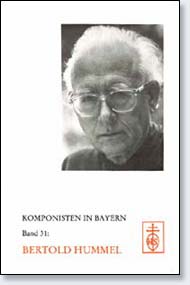
Notes on Bertold Hummel
The break-down of unity within contemporary music has as one of its consequences the risk that the musician is going to be left behind, fallen by the wayside. The unity between instrumentally typical writing and importance of the statement seems undermined. The debate about whether modern music should be part of season-ticket concert programmes or should be found room elsewhere is basically another side of the same dilemma. In the meantime, however, a generation of young performers is growing up - at least in part - with the feeling of having been abandoned by their composer colleagues. The latter demand from orchestral musicians highest levels of technique, flexibility and concentration but largely neglect the need for presentations satisfying on all levels. Particularly amongst the critics there developed a harsh judgement on "Spielmusik" ("music for the joy of playing"), which was considered to rotate in its own little circle without taking account of progressive musical tendencies of the time.
But the need remained unmet. To counter this, there developed in Germany a style of composition which took its direction particularly from the works of Paul Hindemith. Today, these compositions have again found a much more convinced audience. Bertold Hummel is one such composer and can be seen as a "grandchild" of Hindemith via his teacher Harald Genzmer. Here there is no timidity about getting involved with forms catering for the pure pleasure of instrumental playing or about music reflecting pedagogical needs. These compositions meet with great resonance, as is evident from the number of performances, which often exceed those of the avant-garde by a long way.
Bertold Hummel, born in 1925 in Huefingen, which happens to be near Donaueschingen, where Hindemith at that time organised his concerts with contemporary music, is not considered as part of this avant-garde with its self-isolating tendencies, in its self-imposed ghetto situation. He has never attempted with his music to break out of the traditional concert forms but sees it rather as a deeply-rooted form of musical communication with wide-ranging possibilities from great concert halls to the church. Thus church music was for the Catholic Hummel one of the central areas of activity. It was in this field that last year a monumental, two-and-a-half-hour major work, the oratorio, "The Shrine of the Martyrs", was composed and performed for the first time in Wuerzburg where Hummel was active from 1963 onwards as a teacher of composition. Between 1979 and 1997, he was president of the state music college in Wuerzburg and was besides this director of the Studio for New Music, Wuerzburg.
Many of Hummel's compositions were written in connection with concerts for the Studio for New Music and also in collaboration with the percussion class of Siegfried Fink. In these works, there is a combination of pedagogical intention with a completely personal style offering room for the performer to exploit his instrument.
Originality as well as "usefulness" of the music were always at the centre of Bertold Hummel's compositional thinking. In this, he relied in large measured on the musical schemes of the baroque and classical periods, the Sonatina, the Divertimento and also the Suite recurring as the basis for his works, particularly when the emphasis was on the combination of instrumental enjoyment with pedagogical aims.
In more freely conceived works, of perhaps greater significance than the category mentioned, there resulted from impulses he absorbed from contact with the new discoveries of the avant-garde a "sound-colour" style, linked closely to Hummel's unusual abilities in the area of instrumentation. Here again he saw himself however as being on the side of the "users", as meant in his fundamental definition of two basic types of artist, of composer, as he saw them in history: the "discoverers" (Hummel described them as lighthouses and included here such figures as Haydn, Beethoven, Liszt, Debussy or Schšnberg) and the "amalgamators", amongst whom he mentions Bach, Mozart or Brahms. Hummel felt himself closer to the second group in his creative work, he attempted constantly to integrate harmoniously experiments and their results in his work, to place these, seen as it were through his eyes, at the disposal of performers. This does of course always run the risk of becoming schematic, but the element of originality provides the counterweight to this. It is on this latter element that the success of a work ultimately depends. But the work has to be able to resist the pressure from pedagogical impetus, from the wishes of the instrumentalist for enjoyably performable material and from the wish for individuality. Otherwise the work will fall under the wheels of banality or of elitism.
(from the programme booklet of the Munich Philharmonic: 2nd Chamber Concert, Munich, 1990, p.4-5)
Claus Kühnl
Bertold Hummel extends classical order - composer in the twentieth century
Bertold Hummel, whose
field was composing and not precise speaking and writing about music, has
described himself on a number of occasions in the last five years, looking back
on his work, as a eclecticist. Since he was, of course, aware that this term is
generally used in a negative sense—“eclectic” means selecting from existing
material, therefore non-original—he sometimes spoke of a “creative
eclecticism”.
In the obituary in the
Frankfurter Allgemeine Zeitung of 12th August 2002, Michael Gassmann
wrote, “He saw himself as someone ‘who has observed and analysed the
experiments in their entirety’. Bertold Hummel was thus what an avant-gardist
is not–but he was filled with enthusiasm.” This formulation seems to me
somewhat exaggerated, but it contains a core of truth. How, then, is Bertold
Hummel’s creative work in music to be distinguished from the avant-garde of the
fifties and sixties, for these were the decisive years of his generation, and,
if he was enthusiastic, what was he enthusiastic about? A statement of
programmatic relevance to the whole musical avant-garde was formulated by
Karl-Heinz Stockhausen in his Arbeitsbericht [Work Report] 1952/53, whose
aesthetic approach was as follows: “One can no longer rely on the immediate
sound ideal. The sound ideal is determined by all the music one has previously
heard. If it still had validity, one would also have to continue to conform to
classical order.[1]
The creative alternative
to continuing as things always have been has produced, as we know, serial and
electronic music, the latter’s genesis being achieved initially with serial
methods. Bertold Hummel did not in fact construct any of his works on serial
techniques. He once mentioned to me that, in his first stages, he carried out
studies with total predetermination of pitches, durations and timbres, but was
apparently repelled by the results. Hummel saw no personal necessity to deny
the validity of the precepts of classicism. Nor did he, naturally, wish to
comply with them unquestioningly. He wished to extend these precepts where his
creative curiosity called for it and enrich them with solutions of his own:
this was his concept of originality, a concept repeatedly emphasised to me at
the start of my studies with him. He therefore strove, with increasing
persistence from the seventies onwards, for a personal style, while the
avant-garde expressly abjured such efforts and, in a certain sense, wanted to
discover music anew with each work. This was the direction indicated by a
statement of the then young composer Isabel Mundry: “Distrust, in a creative
sense, what you are already capable of–I hope, in this way, to preserve myself
and, at the same time, to remain in motion. Perhaps one will more readily
attain an authenticity if one avoids cultivating it.”[2] Could it be that two
irreconcilable attitudes collide here?
The fact is that Bertold Hummel, up to
the very end, accorded priority in his working process to creative spontaneity,
following up with precise determination of every detail. That one of the determining
factors in his sound ideal was “all the music that one has previously heard”
was for him completely natural and not a reason to rebel against this fact. He
was, furthermore, knowledgeable about all the achievements of his epoch,
including those whose blessings he did not accept. One could say, regarding the
music of his time, that he was excellently informed, and all who knew him were
aware that he was to be seen in Donaueschingen every year, hardly missed an
important radio transmission in his region and, with his students of the day,
thought through everything that was presented to him. He did, however, like
every composer, have certain preferences. He loved Gregorian chant, the
classics, Anton Bruckner, Alban Berg, Paul Hindemith and Olivier Messiaen, with
whom he also felt connected in a vivification of Catholicism. He was
enthusiastic about them, their music permeated him and, thanks to his
transforming personality, brought forth a new style.
[1] Karl-Heinz Stockhausen, Texte zur elektronischen und instrumentalen Musik, Cologne, 1963, p. 32
[2] Isabel Mundry, booklet text for the CD of the Deutscher Musikrat, WERG
Notes
on Bertold Hummel / Plea for the original oeuvre of the contemporary Composer
“He composes!” This
reputation had already preceded the young cellist Bertold Hummel at the time
when he was studying at the Music College in Freiburg in the years after the
war. We grammar school pupils, especially those interested in music, heard of
it with admiration. There were some young geniuses at this College, re-founded
after the war: the best-known were Fritz Wunderlich and Dietrich
Fischer-Dieskau, there were singers, violinists, harpsichordists, organists—but
composers? That was something special. What does a composer actually do? We
imagined that he tried out chords on the piano and jotted down sketches on a
leaf of paper; or we saw him sitting in front of enormous pages of a score with
many staves and clefs—in command of the music as a ship’s captain was of the
sea and the waves. Our respect grew even more when a Mass by the as yet unknown
composer Hummel received its prèmiere at the Donaueschingen Music Festival.
That Hans Heinz Stuckenschmidt tore the work and the performance to shreds did
not intimidate us. We were proud of Bertold Hummel and furious with
Stuckenschmidt (at the time a kind of Reich-Ranicki of music criticism!).
I
remember an appearance of Paul Hindemith at the Freiburg Music College, it must
have been 1949 or 1950. Those interested in music at the Berthold Grammar
School would gladly have played truant to see the famous man. There was an
astonishing thronging of the steps of the beautiful of Baroque palace on the
Minster Square as the small, lively, well-rounded Hindemith began to deliver,
speaking at an almost unbelievable speed, an improvised but highly scholarly
speech on music theory. Harald Genzmer, a pupil of Hindemith, Professor for
Composition in Freiburg and Hummel’s teacher, was there. At that time, one
thought became established in my mind: Hindemith, Genzmer, Hummel—they must
belong together! And it was true; and Stuckenschmidt’s reaction appears for me
today in this light: it was simply not admissible for anything else, anything
independent, to manifest life alongside the Vienna School, which he represented
on a journalistic level. Luckily, Bertold Hummel had strong nerves and, while
duly modest, also the necessary self-confidence. On finishing his studies, he
first set off on concert tours which took him as far as South Africa, appearing
as cellist and composer in one person. He then settled down, married the
violinist Inken Steffen in 1955, worked as a church musician in Freiburg and in
freelance activities with South-West Radio Baden-Baden.
With an impish glint in
his eye, he told how the musicians had groaned during rehearsals of one of his
not-so-easy scores and complained: “Of mathematical music, sir, we be
particular fond!” Otherwise he worked on incessantly and absorbed the entire
modern field, including the Vienna School. Even then, Bertold Hummel had an
astonishing stylistic breadth: besides extremely refined structures demanding
great agility, he could also write straightforward pieces for amateurs, could
adapt himself to different levels of ability, could weigh up and compensate—in
the same way, as a teacher of composition, he later fired on the melodic
talents to write counterpoint and encouraged the rhythmically gifted to work on
melody.
The
moment came for Bertold Hummel as a teacher of composition in 1963, when the
Bavarian State Conservatory, Würzburg, called him as teacher of composition.
Since then, Würzburg has been for him, his wife and his six sons—all highly
musical, five musicians themselves!—at the centre of life. He founded and
directed the Studio for New Music, Würzburg, and he can be considered one of
the founding fathers of the Higher Music College in Würzburg, to which he belonged
as a Professor and later as long-time President and Honorary President, which
he still is. But it was for him equally self-evident that he should take part
in music at the cathedral. No less a person than a bishop, Paul Werner Scheele,
wrote the libretto for his magnum opus of church music, “The Shrine of the
Martyrs”—this in a time which was not at all favourable for demanding music,
and in which the sceptical question had already been voiced, in 1979, of
whether is still possible, within the church, to “conduct the discussion about
over-intellectualisation, without which no upturn can be expected”. What
impression does Bertold Hummel’s work of over 100 opus numbers, in manuscripts,
scores, print, in numerous discs and CDs, make on us? In the first place, it
has an unusually multi-facetted character. The work index completed in 1995
runs to 30 pages and included almost all compositional genres: works for the
stage, for instruments and voices, music for plays, radio plays and films, one
chamber opera, three ballets, three symphonies and numerous works for large and
small orchestras, a plenitude of chamber music for wind and strings,
compositions for guitar, harp, piano, organ and—as a special accent—percussion,
a wide range of sacred vocal works, including an oratorio, six Masses, Propers,
motets, cantatas and solo song, and secular vocal works from choral works to
solo song. Although Bertold Hummel knows and has at his command the linguistics
of modern music, his works cannot, however, be reduced to a single formula. He
is no musical constructivist, no neoclassicist, no polystylist, no adept of the
post-modern. Is he then—as is sometimes suspected, with a dark glance, of
pupils of the Hindemith and Genzmer school—a “practical musician” at the
service of rhythmic and motor skills? Anything but! In the same measure as his
music may be burstingly full of vital energy, the working out shows prudence
and awareness, wit and lucidity. Precise craftsmanship is happily complemented
by virtuosity and sense of timbre. The solo sections, in particular, often
represent pinnacles of agility and refinement. This music makes some demands on
the listener, but never loses him out of sight and mind. The triangle of
composer/interpreter/listener remains, on Hummel’s own admission, a constant
challenge. And the parameters of melody, rhythm and harmony must, in his
opinion, constantly be brought anew into an exciting balance. Hummel’s music is
not content to remain in the pathos of distance—it demands a listener. It does
not intend, it is true, to flatter the listener, and certainly not to lull him
into a sweet sleep, but confronts him, wishes to say something to him. The same
is true of Hummel’s church music, which occupies a natural place in his œuvre.
For the spiritual and the profane — the skill to sing a Gloria or to play for
dancing — are not fundamentally separated in his case: they belong together and
complement each other. The sacred music forms a continuum within the composer’s
production. It connects the phases of his life’s work.
In Bertold Hummel’s
workshop, nothing is lost. As a nine-year-old, for example, he heard Bruckner’s
Third Symphony in Freiburg and reached this conviction: “I must become a
composer!” He notated a four-bar sequence of chords which he quoted, much later,
in his three-movement organ work "In memoriam Anton Bruckner",
premièred in 1989 at the Leipzig Gewandhaus. Anton Bruckner and Olivier
Messiaen left their mark on the church musician Bertold Hummel as much as by
their piety as their avant-gardism. His own sacred music is likewise audacious
and astringent, complex and demanding. Time and again, Hummel pointed to the
French organ music of the 20th century and found words of praise for
its succeeding in anchoring the contemporary in the consciousness of the people
of the church, avoiding the ghetto-existence which has often marginalised
sacred music elsewhere. Bertold Hummel has received numerous distinctions. As
early as 1956, he was awarded a bursary by the Federal Association of German
Industry. In 1960, he received the Composition Prize of the City of Stuttgart,
in 1961 the Robert Schumann Prize of the City of Düsseldorf, in 1988 the
Culture Prize of the City of Würzburg. In 1968 he was awarded a bursary by the
Cité des arts internationale de Paris. Since 1982, he has been a member of the
Bavarian Academy of the Fine Arts and gives lectures at home and abroad. The
greatest recognition, of course, are the performances of his works throughout
the world, mainly in, besides Europe, the USA, South America, Canada, Russia,
Japan, Australia. One would wish Germany—and Bavaria—similar record figures.
While the prophet may not be unknown in his own land, a little more familiarity
would be appropriate. For his music — as Karl Schumann said at Hummel’s 65th
birthday — “has what one would desire: substance and professionality,
individuality and polished compositional technique, precise craftsmanship and
profundity…” Not least, this composer also speaks to those “who hear beyond the
details of constantly idiosyncratic and polished compositional techniques.”
(Rheinischer Merkur, Number 22, 30th May, 1997)
One has become all too
accustomed in our times to measuring a composer by the “new” that he has
discovered. New effects are experienced as a sensation, and yet they are
meaningless as long as they are not based on an inner necessity. In this sense,
Hummel can certainly not be counted amongst the avant-gardists. But the
opposite would be equally false, to include him with the traditionalists, for
example. Hummel was a master of all essential recent compositional techniques
and also made sensible use of these in his works. His works are therefore
particularly suitable for imparting a spontaneous experience of new music.
Claus
Kühnl (1977, LP booklet text: LP: Christophorus 73902)